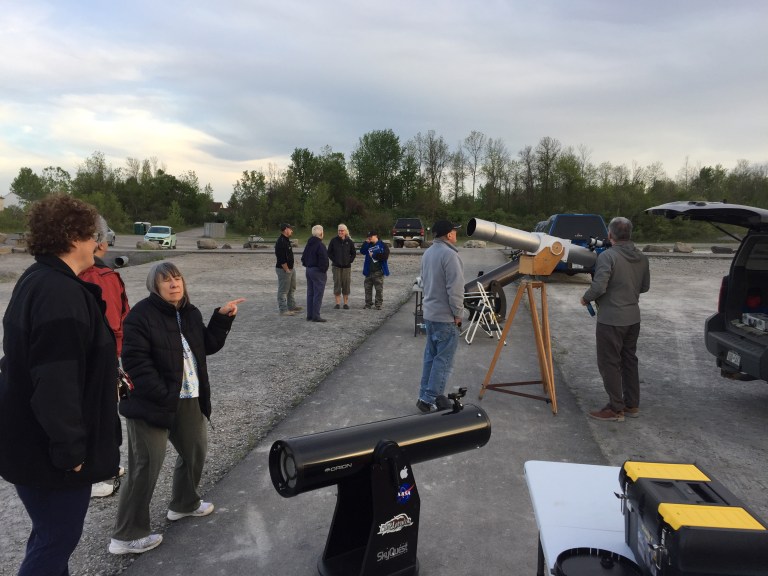
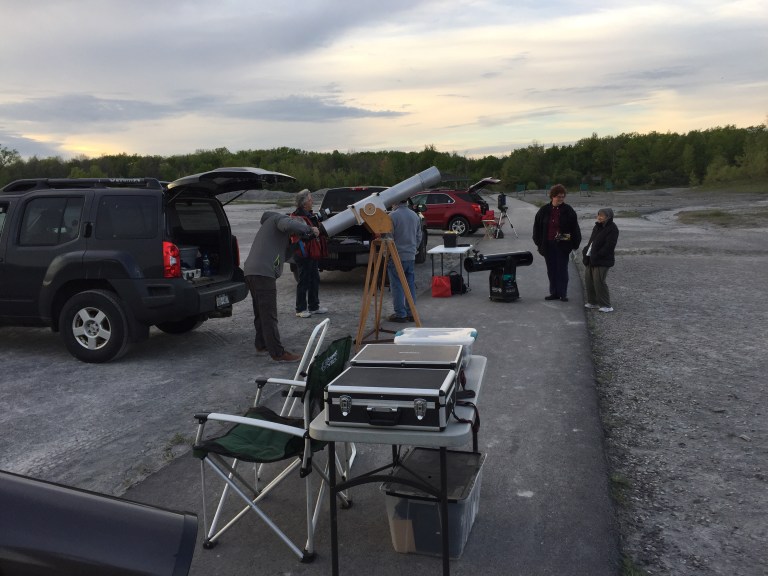
On Saturday June 10th Penn dixie had the pleasure of hosting an outstanding group of young ladies (and their moms) from Troop 31339 from Orchard Park. The troop contacted Penn Dixie to work on their Sky Badge. The special event, marked the first successful astronomy program of the year, the weather was perfect. We took them on a tour of the night sky, identifying various stars, constellations, and we were able to view many awesome celestial objects. We had three telescopes set up, two for visual observing and one for imaging. We also had an opportunity to discuss the upcoming eclipse on August 21st.
Here are few pictures from the evening. Note: All images of celestial objects were captured during the event at Penn Dixie by Penn Dixie’s Jim Maroney.
Members of the troop trying out eclipse glasses as the Sun was setting. Picture taken by Ernie Jacobs.An image of Jupiter captured during the event. Image was captured and processed by Penn Dixie’s Jim Maroney.Messier 13 – The Globular Cluster in the Constellation Hercules. M13 is about 145 light-years across, 25,100 light-years away, and contains several hundred thousand stars. Image captured and processed by Penn Dixie’s Jim Maroney.The Visual Double Star Mizar and Alcor located in the handle of the Big Dipper. Mizar itself is actually a quadruple star system and Alcor is a binary star system. Together they comprise a sextuple star system! Image captured and processed by Penn Dixie’s Jim Maroney.
Hopefully this marks an improvement with regard to our luck with the weather. Our next event is this coming Saturday June 17th at 8:30 pm. We hope to see you there!
Mother Nature has not been very cooperative with regard to our Penn Dixie Astronomy programs this year. Our March and April events were cancelled due to weather. We were mostly foiled again this past Saturday evening (5/20) for our Jupiter at the Meridian event. After a mostly cloud free sky all day long, the clouds rolled in before sunset. I say mostly foiled because we weren’t completely foiled.
We did have a brief window of opportunity to view Jupiter through multiple telescopes as we were fortunate to be joined by several members of the Buffalo Astronomical Association (BAA). Both Jim Maroney and I belong to the BAA in addition to volunteering with Penn Dixie.
We really appreciate our colleagues taking the time to share their time and experience with us and visitors to the site. Specifically I would like to thank Steve Smith, Dennis Brylinski, and Mike Anzalone. Check out the BAA at Buffaloastronomy.com. They hold monthly public nights at their Beaver Meadow Observatory (1st Saturday of the month thru October) and BAA member Steve Smith holds monthly star parties in Wilson, NY (Wilson Star Search – 2nd Saturday of the month thru October).
Astronomers setting up Saturday May 20th hoping for clear skies. We did get a brief window to provide visitors to the site views of Jupiter through multiple telescopes.
Of course the big Astronomy event for 2017 will be the Great American Eclipse on August 21st. To experience totality (highly recommended) you will need to travel to the roughly 100 mile wide band that will cut across America from Oregon to South Carolina. Western New York will experience a partial eclipse. Approximately 75% of the face of the Sun will be blocked by the Moon. Penn Dixie is also coordinating with other local organizations to provide safe viewing opportunities for Western New Yorkers. Check out BuffaloEclipse.org for more information.
A map of the upcoming Total Eclipses of the Sun visible in North America.
Hopefully our fortunes with the weather improve for the rest of the season (especially on August 21st for the eclipse)! The next Penn Dixie Astronomy Night is scheduled for Saturday June 17th. We hope to see you there!
Viewing our star and its first planet from the third planet! Several telescopes setup at Penn Dixie to view and capture the images of the May 9th Transit of Mercury.
On May 9th 2016 about 120 people took advantage of the opportunity and the fantastic weather to view the Transit of Mercury. During this event, the solar system’s smallest planet crossed the face of the Sun from our point of view here on Earth. Mercury made a crisp, perfectly round, and completely black image against the bright surface of the Sun, in markd contrast to the irregular and fuzzy sunspots also visible on the surface of the Sun at the same time. The site was open for the event from 7 AM thru 3 PM. We had 3 astronomers available with 6 scopes set up viewing of the event. About 32 guests and 60 3rd graders along with 30 Teachers/Chaperones from Buffalo Public School # 81 were on hand to witness the event.
So exactly what is a Transit? An astronomical transit is when one celestial body like a planet or a moon appears to move across the face of another celestial body, like a star for example, as seen from observer on a particular vantage point (in our case, on Earth). So from our perspective here on Earth, only the planets Mercury & Venus and the Moon can transit the Sun. When the moon passes across the face of Sun we call that a Solar Eclipse. In this case Mercury, the solar system’s smallest planet and the closest planet to the Sun, passed in front of the Sun from 7:12 AM EST to 2:42 PM EST and was visible to observers in the eastern United States and Western Europe. Mercury appeared as tiny black dot 10 arcseconds wide moving across the face of the Sun (about 1/200th the width of the Sun). If Mercury was the same size as the Earth, the tiny dot would only appear 2.6 times larger as it traveled across the face of the Sun.
Cropped image of Mercury during the Transit captured by Jim Maroney on his 8″ Celestron Edge HD with CCD camera. Multiple images were captured and stacked in special software to create this image.
How rare are Transits of Mercury? Transits of Mercury occur about 13 or 14 times per century, so they are rare, but nearly as rare as Transits of Venus. The last transit of Mercury was in 2006 and the next one will occur on November 11, 2019. By contrast the next Transit of Venus, which last occurred in 2012, won’t happen until 2117. The 2019 Transit of Mercury will again be visible in the Americas and Europe.
Were any pictures taken? In addition to viewing the event visually thru telescopes with special solar filters. (Never look at the Sun without following the proper precautions!!!) Images of the event were captured. Photos and videos were captured via smartphones thru the eyepiece of on of the telescopes and Jim Maroney (Penn Dixie’s resident astrophotographer) had multiple telescopes setup to capture the event. We even managed to broadcast the transit live on our Facebook page for a few minutes until the battery in my iPhone was completely drained.
Ernie Jacobs captured this image of the event using an iPhone, 8″ Dobsonian Telescope, and a 25 mm Plossl eyepiece. A short video was captured on the iPhone. Software broke the video up into individual images, aligned the images, sorted them for quality, and then stacked the highest quality images to create the final image above.
Did I mention the weather was fantastic? We couldn’t have asked for a better day, hardly a cloud in the sky. Clearly as an astronomer, I am better suited for observing at night. Yes, I spent the whole day outside observing the Sun without putting on any sunscreen, Ouch!
All in all it was a spectacular day. Thanks to my fellow astronomers Rich Switzer and Jim Maroney for sharing their time and expertise and thanks to the volunteers and staff that helped organize and run the event. Clear Skies!