The Hamburg Natural History Society, which governs the Penn Dixie Paleontological & Outdoor Education Center in Hamburg, NY, is pleased to announce an award of $3,875 from Ronald McDonald House Charities of Western New York.
The grant will be used to purchase telescopes and microscopes towards the development of new astronomy programming at the Penn Dixie Site. The programming will augment existing volunteer-based efforts and will support the creation of new, hands-on science activities. These programs will be open to the public and local K-12 and scout groups.
The award will also add a digital projector, screen, and power stations for microscopes to Penn Dixie’s outdoor classroom. Given new capabilities, Penn Dixie will now be able to create an outdoor science lab that will be ideal for hands-on inquiry investigations of the natural world. Additionally, the grant will be used to develop culturally relevant astronomy programming for local Native American students.
The grant monies used to support this award were raised through the efforts of the local McDonald’s restaurants in the Western New York community, and in part by national McDonald’s promotional programs. Ronald McDonald House Charities provides lodging, comfort and emotional support to families of children receiving medical treatment at area hospitals, and reaches out to families in the community by supporting programs that benefit children.
Photo credit RMHC. Includes: Sarah Tarnowski (PD Director of Education), Joseph Ferrino (RMHC Director), Phil Stokes (PD Executive Director), and Jim Eiseman (PD Director) at the RMHC award ceremony in November 2016.
Additionally, Penn Dixie thanks Patrick Miller, Ernie Jacobs, and Jim Maroney for their assistance in securing this funding.
A closer look at our 2016 attendance by HNHS/Penn Dixie Executive Director Dr. Phil Stokes
Penn Dixie’s 2016 May to September general admissions.
We’ve received a lot of feedback about our huge boost in attendance this year. While much of the feedback is positive, there’s some genuine curiosity as well. So, I thought that I’d share some of our strategies with our supporters. First, some notes:
These data only represent general admissions (i.e., visitors who arrived at the site to collect fossils as individuals or small groups). We did not include group programs (e.g., school tours, scout programs), special events (e.g., Dig with the Experts), summer camps, lectures, off-site programs (e.g., Science Nights) and other programming.
We estimated 2014 attendance as these numbers were not digitally available at the time we made our graph.
A more detailed look at our 2016 attendance will be included in our annual report, which will be released this winter.
Onto the discussion
Looking back at our historical attendance, the number of visitors to our site steadily increased throughout the 1990s and 2000s. This was an important time for us — we were an all-volunteer organization for our first decade and relied heavily on word of mouth and newsletters to get the word out. With the hiring of full time and seasonal staff in the mid-2000s, we were able to serve more visitors through expanded collecting days and through improved marketing.
Penn Dixie general admissions attendance, 2011 to 2016.
Recent trends
From 2011 to 2015, we experienced some ups and downs. In 2012 and 2013, Penn Dixie offered new — and greater numbers of — programs and group tours. However, poor weather conditions hurt our general attendance in 2014 and 2015.
You’ll see that we are busiest in July and August, since these are the months when school is out and people are traveling. Our summer visitors are comprised of a mix of local collectors and fossil enthusiasts from around the country and the world. In 2016, for instance, we’ve welcomed visitors from 35 states and five countries. Our visitors represent a breadth of experience levels: some are world-renowned fossil collectors, some are science fans who collect rocks and minerals for fun, and some are first-time collectors.
A mix of summer visitors: trilobite hunters (left) and birthday party fossil hunters (center).
To attract out of town visitors, Penn Dixie relies heavily on internet searches, communications within amateur and professional paleontology communities, brochures in places like the Hamburg Chamber of Commerce, and word of mouth. We’re pleased to have such a good reputation in the fossil collecting community — based on decades of hard work from our staff and volunteers — and will work diligently to keep up our reputation at the top fossil part in the U.S.
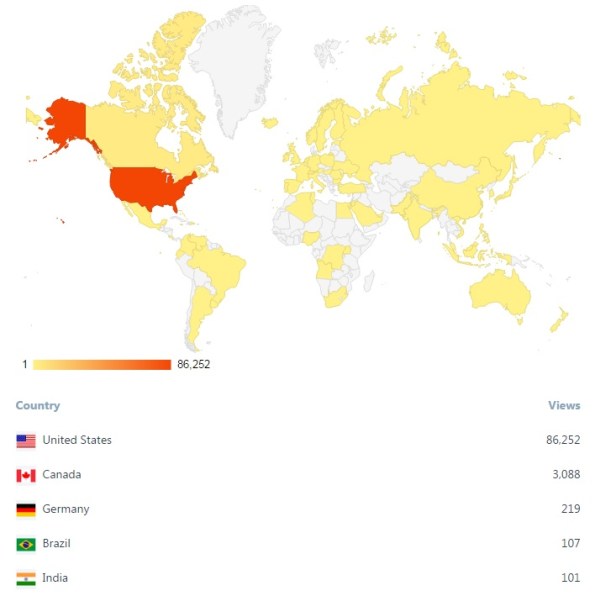
Penn Dixie international web visitors with top five countries shown.
We shifted our marketing
Regional visitors are drawn to Penn Dixie through advertising, word of mouth, and community engagement (e.g., our booths at the Erie County Fair and Hamburg Burgerfest). In the past, these efforts involved many volunteer and staff hours staffing festivals and other events. This year, we refocused our marketing in the region to reach new audiences who might not had previously heard of Penn Dixie. These were some of our initiatives:
A new website. We redesigned our site to be more user friendly and to include as much information about the first-time visitor experience as possible. We wanted our new guests to understand what this fossil collecting business was all about!
Enhanced social media presence. We put our Facebook page on the fast track (see chart below) and it boosted traffic to our website and our physical site. We also created a Twitter account and started blogging — how meta that you’re reading this!
We distributed coupons to participants in our group programs with the hopes that they would bring new visitors to our site.
We shifted some of our advertising from traditional media (e.g., newspapers and magazines) to online media (e.g., Facebook and Google Ads).
We reduced our quantity of community events while increasing the impact of our presence at the events that we did attend. For example, we decided against traveling to the Syracuse Gem & Mineral Show but did attend a children’s fair at SUNY Buffalo.
Our Facebook likes more than doubled over the past year. Facebook is the #2 referrer to our website; Google is #1.
Lucky us
We were fortunate that this combination of changes was successful. As luck would have it, we were also in the right place at the right time. We didn’t know it then, but some visitors from India went back home and decided to open their own fossil park and model it after Penn Dixie. The Buffalo News and Artvoice did an excellent job describing this new partnership. We benefited from a lot of great press this year, and you can see all of the articles on our media page.
The dudes from India with their Penn Dixie plaque.
Similarly, we were excited to host our largest ever Dig with the Experts this spring. Channel 4 News did a live feed from our site the morning before the dig, and our website experienced a surge of visitors as a result. And, as a result, we had even more visitors attend the dig, more new fossil collectors come to the site during the summer, more birthday party bookings, and welcomed many new members to our society. It’s certainly a funny feeling to have a 3rd grader come to the site and say “Hey, I saw you on TV!”
Our luck continued and our high visibility encouraged new advertisers to reach out to us. In a very short period of time, Penn Dixie was approached by Groupon — a nationally recognized leader, Seize the Deal/Townsquare Media — with radio advertising (!), and Entertainment — printers of the famous books — to do promotional deals. Of course we said ‘YES!’ And, each of these deals helped us to further boost our admissions.
The next steps
So, where are we headed? Despite this huge increase, we’re NOT swimming in gold like Uncle Scrooge (below). Sadly, our revenue doesn’t double along with our attendance — though if it did, I’d be writing this from a much more comfortable office chair! Much of our admissions revenue goes towards labor costs, which include staff salaries, payroll taxes, and employee-related expenses such as disability insurance. It’s not very exciting, but that’s the reality of a small nonprofit. For example, just as a great deal of my time is spent away from the fun stuff going on at the site, much of our revenue goes to unexciting things like insurance, bookkeeping/accounting, and other operating expenses. If any insurance or accounting people reading this, I’m sorry!
The good news is that increased attendance allows us to make a stronger case for grants and public funding. More visitors means that more people know and appreciate Penn Dixie, which translates to better chances for us to grow in the future. Plus, if we’re careful about how we commit our staff — and blessed with help from volunteers — we can use some of the proceeds from increased admissions to invest in the future. These funds might go towards the hiring of additional staff — which helps us to offer new programs — and advertising. And, I know that I’d love to work out of a building on the site — which would allow us to remain open year round — and showing increased attendance is perhaps the best way to justify that expense.
One last thought
On a personal note, I love seeing first-time collectors at the site, especially families with young children. We provide an incredible and unique opportunity for science learning at a very affordable cost. Plus, we’re in an outdoors setting, which means that visitors need to tune out their electronic devices to get the full experience. Despite having collected fossils for over two decades, I’m still thrilled every time I find something new — which is very often at Penn Dixie as you probably know — and am encouraged when our guests experience that same feeling.
Fossil hunters at the 2016 Dig with the Experts program in May.
A newly released report from the Hamburg Natural History Society (HNHS) finds that the Penn Dixie Paleontological & Outdoor Education Center’s annual fossil dig — Dig with the Experts — contributed greater than $32,000 in total economic impact to the Hamburg area in 2016.
The report examined the economic benefits generated from the one-day fossil collecting program in which visitors were invited to collect fossils in a freshly excavated portion of the site’s 54-acre quarry. Paleontologists from the Cincinnati area supervised the dig, where participants could unearth 380 million-year-old rocks in search of marine fossils such as trilobites and brachiopods.
Visitors stayed in local lodgings, dined at local restaurants, and visited area attractions while they were in town. About 40 percent of the dig 165 attendees traveled from outside the Buffalo area; a similar number were first-time visitors to Penn Dixie.
HNHS Director David Hanewinckel, who authored the study, stated “We knew Penn Dixie had an economic effect on the area, but before this study, we didn’t know how much we contributed. Now, we have a good number and look forward to continuing success.” The study was conducted by Hanewinckel, HNHS Executive Director Phil Stokes, and Dr. Roger Levine, an independent consultant formerly of the American Institutes for Research.
Penn Dixie typically welcomes 12,000 visitors each year; visitors from 31 states and four countries have visited to date in 2016. Penn Dixie was recognized as the top fossil park in the U.S. following a 2011 study published by the Geological Society of America.
The Environmental Policy Group of Jammu and Kashmir displays a commemorative plaque from Penn Dixie.
You may have read about our new partnership with the Centre for Himalayan Geology in the Buffalo News or Artvoice. With Penn Dixie’s support, The Centre is in the process of creating an international scientific attraction — the Kashmir Triassic Fossil Park — near the town of Khonmoh in the State of Jammu and Kashmir, India.
Gangamopteris, a plant fossil found in Kashmir. Photo from geoinfo.nmt.edu.
Many of the types of fossils found at Penn Dixie are also present in Kashmir, though the species are not the same. For instance, both fossil parks have brachiopods, bivalves (clams), ammonites, gastropods, other marine invertebrates, and various plants. However, the park in Kashmir — at least as far as we can tell — does not have trilobites, as these animals became increasing scarce towards the end of the Paleozoic Era. The Permian-Triassic extinction event — which is captured in the rocks at the park — marked the end of the trilobites’ reign on our planet.
An example of Permian foraminifera — microscopic plankton fossils found in India. Photo from http://www.nrm.se.
This massive die-off — which eliminated 90% of all marine species and 70% of all terrestrial vertebrates on Earth — led to the rise of the dinosaurs. Meteor impacts, widespread volcanism, and a runaway greenhouse effect (i.e., climate change) have been proposed by scientists as explanations for the extinction event.
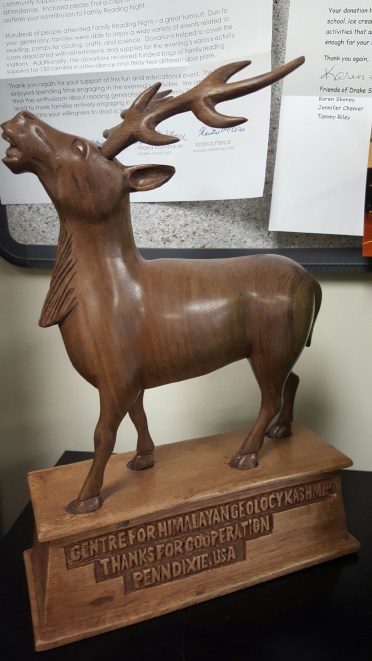
Carving of a Kashmir stag, or hangul; a gift from The Centre to Penn Dixie.
For some additional reading about the park, visit these links: